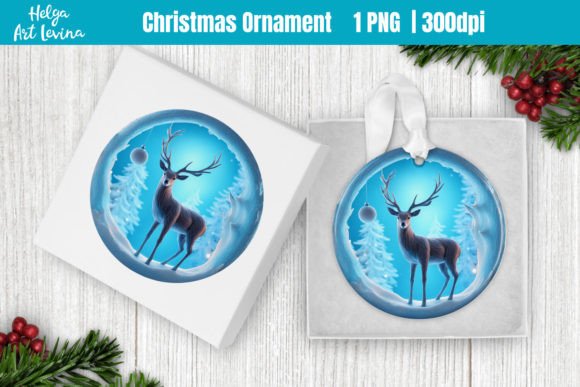
Review: Christmas Ornaments Deer Sublimation for Embroidery
As a designer who spends more time staring at stitch previews than I do sleeping, I approach every new digital embroidery file with a healthy dose of skepticism. We have all been burned by beautiful graphics that turn into thread nightmares once the machine starts humming. So, when I pulled up the Christmas Ornaments Deer Sublimation design to evaluate it for real-world application, my first instinct wasn't to admire the art, but to dissect its potential as a machine embroidery design. This isn't just about whether it looks cute on a screen; it is about whether it survives the transition from pixel to thread on a client's favorite sweatshirt.
First Impressions and Visual Personality
The initial visual impact of this piece is undeniably festive. Falling under the category of Illustrations, the design carries a whimsical, storybook quality that immediately signals "holiday season" without relying on cliché red-and-green overload. The silhouette of the deer, framed within an ornament shape, offers a clean, contained layout that is generally friendly to embroidery hoops. However, the sublimation origin of the artwork presents specific challenges. Sublimation designs often rely on soft gradients and fine lines that do not always translate well to satin stitch or fill stitch techniques without significant manual digitizing adjustments.
If you are using this as a printed transfer for sublimation blank products, the detail level is likely perfect. But for those of us looking to stitch this, the mood it creates is cozy and nostalgic, making it an ideal candidate for boutique holiday collections. The visual personality suggests warmth, making it a strong contender for personalized gift items where emotional connection drives the sale. Yet, the devil is in the details, specifically regarding how those delicate illustration lines will hold up under the tension of thread.
Real-World Application: The Holiday Tote Scenario
To truly test the viability of Christmas Ornaments Deer Sublimation, I imagined a specific project: a custom order for a local boutique needing fifty tote bag design units for their December pop-up shop. The client wanted something elegant but durable. Here is where the practical judgment kicks in. If I were to apply this design directly as a complex fill on a canvas tote, the stitch density might become an issue. Canvas has a distinct fabric texture that can fight against dense stitching, leading to puckering or a stiff, cardboard-like hand feel.
In this scenario, the smart move would be to adapt the design. Instead of a full fill, I would consider converting the deer outline into a bold running stitch or a narrow satin column, perhaps treating the ornament bauble as an applique design. By cutting a piece of felt or wool blend in the shape of the ornament and stitching the deer over it, you reduce the total stitch count while adding a lovely tactile dimension. This approach transforms the embroidery project from a flat print imitation into a textured handmade product that justifies a higher price point. For a small shop product, that added value is crucial for standing out against mass-produced imports.
Navigating Fabric and Hoop Constraints
One of the most critical aspects of reviewing any design is understanding where it fails. Christmas Ornaments Deer Sublimation features intricate elements that demand caution. If you are planning sweatshirt embroidery, the fleece backing usually supports heavier stitching, but you must be wary of the hoop size. If the ornament includes tiny text or extremely fine antler details, they may vanish or blob together on a textured knit fabric. Always check the minimum stitch length recommended by your digitizer.
Furthermore, curved surfaces like caps present a unique challenge. The rigid structure of a cap front panel can distort circular designs if the stabilizer isn't robust enough. For this specific deer motif, I would advise against using it on a curved surface unless the design is simplified. The risk of the ornament looking oval or distorted after stitching is high. Similarly, on thin fabrics like baby onesies for baby embroidery, a heavy fill could cause discomfort. In these cases, reducing the density or using a lighter weight stabilizer is non-negotiable to ensure the finished product is wearable and soft.
Strategic Use for Commercial Success
For Etsy seller accounts and creative entrepreneurs, the versatility of this design lies in its adaptability. It works beautifully on kitchen towel sets, aprons, and pillow covers where the fabric is stable and the hoop area is generous. When used for holiday embroidery on home decor, the design acts as a focal point that elevates a simple linen cover into a seasonal statement piece. However, for commercial embroidery runs, consistency is key. You must ensure that your thread colors match perfectly across every unit. A slight variation in the shade of green or gold can make a batch of fifty look unprofessional.
It is also worth considering how this design performs in marketing materials. Before committing to production, create a printable mockup or a digital preview showing the design on various backgrounds. Does it pop against navy blue? Does it get lost on black? Testing the design in black and white mockups can also reveal if the contrast relies too heavily on color rather than form. If the shape holds up in grayscale, it is a robust design. If it disappears, you may need to adjust the outlining or spacing.
Final Verdict and Designer Notes
Ultimately, Christmas Ornaments Deer Sublimation is a charming asset that, with the right technical approach, can yield stunning results. It is not a "load and go" file for every situation. Success depends on respecting the limitations of the medium. Before stitching a single client item, always test the design on scrap fabric that matches your final material. Check the pull of the stitches, inspect the small details for clarity, and verify that the stabilizer is doing its job without leaving residue.
Remember to confirm licensing terms before selling finished items or digital adaptations. Just because a file is available does not automatically grant commercial embroidery rights. Treat this design as a foundation for creativity rather than a final solution. By adjusting stitch types, respecting fabric limitations, and focusing on the end-user experience, you can turn this illustration into a best-selling custom apparel item or a cherished personalized gift. The goal is to create a finished product that looks as good in hand as it does on the screen, building trust and recognition for your brand in the process.